
From Fixing to Walking Alongside: What Completing My Master's Thesis Taught Me About Trauma, the Body, and Healing
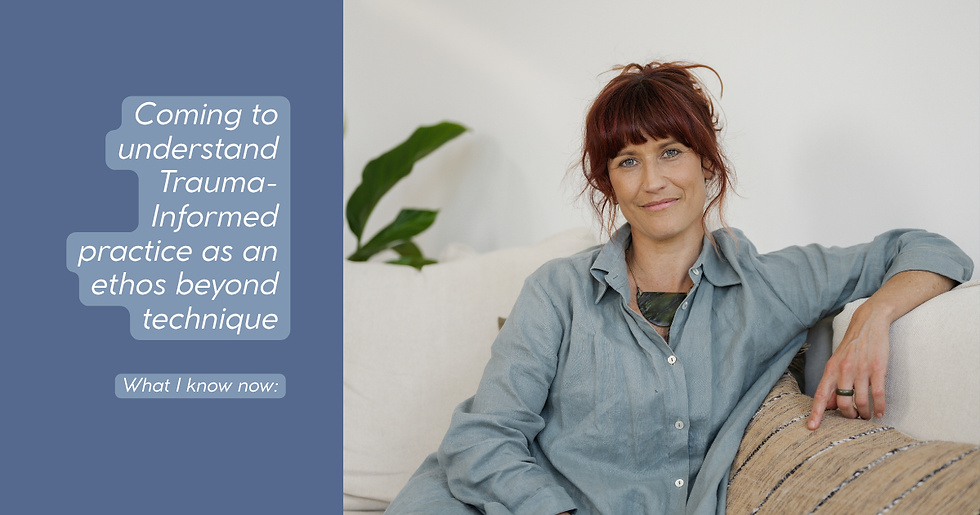
I handed in my Master's thesis in Dance Movement Therapy, and the feeling wasn't quite what I expected.
There was no sudden sense of finally knowing enough, being enough, or a sudden arrival into confidence.
Over the past five years, I've been studying, practicing, dancing, crying, writing, burning out, recovering, and asking one question that has followed me for more than two decades:
How can we work with our bodies, with movement and creativity, to help heal from hard and traumatic experiences — without sacrificing ourselves in the process?
What follows is the heart of what this question uncovered - a story of the wobbly, deeply human sense of still becoming.
"Born Running": How My Body Led Me Here
I arrived on a hot January evening in 1976, “born running,” according to my mum.
By eight, I was choreographing dances with my cousins.
By my teens, I lived at the gym.
In my twenties, I was a devoted yogi, personal trainer, and nutrition nerd.
I was doing everything "right" yet still feeling like something essential was missing.

What I craved wasn't fitness. It was movement with meaning — a way of working with all the parts of a person: physical, mental, emotional, relational, and spiritual.
A three-year contemporary dance degree opened that door. Then motherhood, postnatal depression, and discovering conscious dance and creative arts practices took me deeper. On those dance floors, something clicked: movement, creativity, and relationships can be medicine.
Fast forward to mid-life, perimenopause, and an autoimmune diagnosis — brain fog, fatigue, and a body that refuses to be pushed the way it once was. Writing a Master's thesis through all of that was, as you might imagine, a lot.
But it forced me to turn my own trauma-sensitive principles back on myself: to slow down, to respect my limits, to listen instead of override. And in doing so, it sharpened everything I believe about healing.
What the Research Actually Says About Trauma (In Human Language, Not Academic-Speak)
For a long time in the West, trauma was either ignored, hidden, or treated as a personal weakness. Different eras focused on "hysterical" women, then "shell-shocked" soldiers, then survivors of sexual and domestic violence. Who was believed — and who was dismissed — almost always came down to power, gender, race, and politics.
At the same time, many Indigenous cultures have always understood what Western science is still catching up with: body, mind, spirit, land, and community are all connected. Healing isn't just individual; it's relational.
Modern neuroscience now supports what many people have known in their bones for generations:
Trauma is not just "in your head." It lives in your nervous system and your body.
In threat, our bodies do exactly what they're designed to do — fight, flee, freeze, or shut down. These are survival responses, not personal failures.
Traumatic memories don't always store as neat, linear stories. They show up as body sensations, images, impulses, nightmares, or sudden floods of feeling. This is why "just talking about it" can be overwhelming, or even re-traumatising, for some people.
Because of this, trauma care is slowly shifting.
Instead of only asking, "What happened? Tell me everything," more practitioners are asking:
"How is this living in your body and life right now?"
"What helps you feel a tiny bit safer, more present, more connected?"
"How can we work with breath, movement, rhythm, creativity, and relationship to support your nervous system — not override it?"
Body-based and creative approaches — like trauma-sensitive yoga, Dance Movement Therapy, somatic therapies, and expressive arts — don't always require people to retell their stories in detail. They focus on building safety first, working gently with present-moment sensation and emotion, offering real choice and pacing, and honouring culture, community, and connection.
Underneath it all is a quiet but radical shift:
From "What's wrong with you?" to "How did your body keep you alive — and what do you need now?"
Learning to See the Body as an Ally, Not the Enemy
For a long time, I related to my body as something to manage, push, sculpt, or get under control. Gym culture, perfectionism, anxiety, and the relentless noise of beauty and wellness "norms" - all of it fed a quiet belief that my body might be the problem.
Twenty years of somatic and creative work have slowly gifted me a different frame.
What if my body has been on my side the whole time?
In trauma-sensitive practice, I've learned to see things like racing heart, numbness, freezing, tight shoulders, gut knots, overworking, and spacing out - not as "bad habits" or "symptoms to get rid of," but as survival responses that once kept someone safe.

When I meet my own body that way — as an incredible survivalist doing the best it could with what it had — something softens. There's more room for:
Curiosity instead of criticism
Pacing instead of pushing
"Thank you for keeping me alive" instead of "Why are you like this?"
This is at the heart of my work now, with myself and with the people I support. Not forcing our bodies to behave — but listening for what they've been trying to say.
From Fixing to Walking Alongside
When I started out, I believed being a "good" therapist meant knowing the right answers, having a clear plan, and working hard enough to make something change.
Over time, something softer has grown in its place.
My work has become less about finding the perfect technique and more about an ethos. Trauma-sensitive practice, for me, now means:
Not forcing - being as non-coercive as possible, even when I desperately want to help
Honouring survival - seeing fight, flight, freeze, and shutdown as intelligent, not "wrong"
Treating the body as an ally - a place that holds pain and possibility, hurt and wisdom
Remembering the relationship goes both ways - we affect each other
Seeing self-care as an ethical responsibility, not a luxury
I used to think a "good helper" disappeared into the background and pushed through no matter what. Burnout, autoimmune symptoms, and mid-life have made it very clear: ignoring my own body isn't noble - it's risky. For me, and for the people I work with.
Now I ask different questions in my practice:
Does this invitation support this person's agency, wisdom, and dignity?
Is this likely to widen or shrink their window of tolerance right now?
How might culture, history, and power dynamics be showing up in this room - and in our bodies?
Am I grounded enough in this moment to offer this safely?
If the answer is no, the technique — however elegant — waits.
On Never Feeling "Enough" (And Why That Might Actually Be Okay)
When I started my Master's, I secretly hoped for a moment at the end where I'd finally feel it: I've got this.
That didn't happen.
I've learned so much - about trauma, the body, creativity, ethics, power dynamics, and culture. I can name my values and the kind of therapist I'm trying to be. And still, the doubt is here.
If anything, the more I learn, the more I see how much I don't know.
For a while, I saw this as failure. Wasn't this work meant to fix my not-enoughness?
But I'm slowly realising something softer. In work with trauma and bodies, complete certainty might not only be impossible — it might also be unhelpful.
A little doubt keeps me:
Asking for supervision
Staying genuinely curious
Noticing power imbalances and dynamics
Not positioning myself as "the expert who knows best"
What makes this tolerable isn't pushing the doubt away. It's not being alone with it. Again and again, it's community that steadies me: dancing, art-making, journaling, therapy, supervision, trusted colleagues, and movement spaces where questions are welcome and nothing has to be neatly resolved.

One of my teachers once said: "Sometimes we don't ask questions to get answers — we ask them, and then wait to see what happens next."
I'm starting to treat my "Am I enough?" not as a problem to fix, but as an ongoing question to live with.
Always, I Am Becoming
I called my thesis my "autobodyography" - a timeline of my embodied becoming.
Not a tidy success story. More like a map drawn in pencil, sweat, tears, and dance steps.
Writing it meant turning toward things I'd often tried to outrun: burnout, perfectionism, health changes, doubt, grief, and the tender, ordinary question - who am I becoming as a trauma-sensitive, body-based creative arts therapist, and at what cost?
I didn't arrive at a final answer. What I found instead was a way of walking:
From fixing to walking alongside
From trying to be the "perfect" therapist to being part of a reciprocal relationship, in which we are both affected
From "What's wrong with me/them?" to "What did we survive, and what do we need now?"
From treating self-care as indulgent to seeing it as an ethical necessity
One line from my thesis journal still feels true:
"Always, I am becoming."
This Is the Ground My Work Stands On
No one becomes a trauma-sensitive therapist alone.
Support isn't a bonus - it's non-negotiable.

My thesis was held up by teachers, mentors, fellow students, friends, a women's circle, my family, and the many clients who have trusted me with their stories and their bodies. And, honestly, my own stubborn, wobbly, mid-life self who refused to give up.
If anything in this resonates with you — as a therapist, a client, a carer, or simply a human with a nervous system — I'm glad you're here.
The journey continues in studios and therapy rooms, on dance floors and kitchen floors, in small moments of choosing to listen to our bodies rather than override them.
Let's keep sharing pieces of our becoming. ♥️
X Jess

Comments